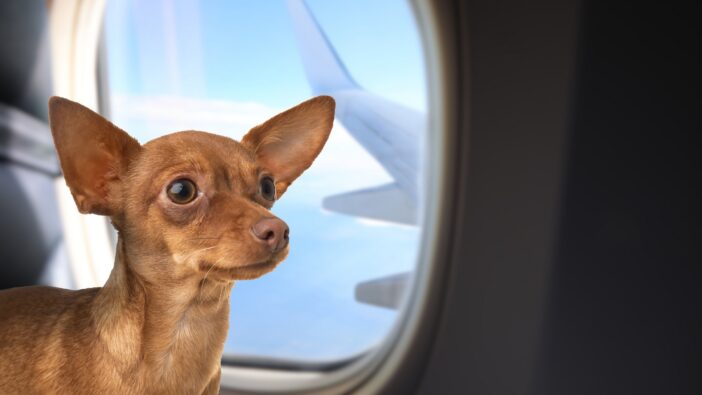
I am on a commercial flight packed full of veterinarians. It makes sense because I’m flying to a big veterinary conference and planning to arrive right as the program kicks off. It’s not like some Twilight Zone moment where 150 veterinarians all feel mysteriously compelled to board the same flight at the same time (although that’s fun to think about).
I know this plane is packed with vets, because they are not difficult to spot. People outside the industry think you can tell veterinarians because you see them oohing and ahhing over pets in the terminal or wearing clothes with cute puppies and kittens on them. Well, those people are not vets. Those are amateur pet lovers.
The veterinarians are the ones sporting fashion provided by the clinic they work for and veterinary expo halls. Think: branded scrub tops, flea medicine hats, and backpacks from animal crematoriums. Vets also don’t ooh and ahh when they see a pet on the plane. They take one look at the breed and whisper something like “get ready for allergies” or simply “IVDD.” Then they shake their heads.
I also know the plane is full of veterinarians because of how the boarding process went. Our flight was nearly delayed because a vet in line somehow got into a conversation with the ticket scanner that just. wouldn’t. end. It didn’t matter that the veterinarian was holding up the entire operation. There were no technicians around to lean into the line and say “Doctor, you have an important phone call on the plane,” so we just had to wait until the vet finally shook loose and said something like “Okay, well… I’ll see you back in a few days!” and then entered the jetway.
When I finally got to my seat, I asked myself “Is it good to be on a flight full of veterinarians?” Unfortunately, the answer is no. Unless you’re the one service dog who got brought on the plane, I can’t think of a scenario where 150 airborne veterinarians is ever going to be useful. Even if you are the service dog and you have a medical emergency mid-flight, I think there’s a dangerously high risk you’ll be crushed to death by all the people who have waited their entire lives for a pilot to say over the intercom “IS THERE A VETERINARIAN ON THE PLANE??”
But if a human had an emergency on the flight… Disaster. Imagine there was a call for any doctors on the plane to come to the front. What then? I’ll tell you. Then you would have ½ the plane sitting in their seats being grateful that their parents weren’t on board to say “They’re probably looking for a real doctor. Don’cha think? I don’t think you need to go up there.” The other half of the plane would be clustered at the front saying “Do you know how many species I work with? I once did surgery in the back of a pickup truck in the rain! Just tell me what the problem is.” It would be chaos.
Also, if the plane starts to have flight problems, we vets are not mechanically inclined. If a technician ever walks into a surgery suite and sees me “fixing” the anesthesia machine, they do not need to ask me if I would like some help. The fact that I’m tinkering indicates things have gone horribly wrong and they will only improve when I am removed from the mechanical part of the procedure. As a general rule, if a plane starts going down, I think veterinarians are less likely to grab a wrench than to start their “well, she’s had a good long life” speech.
And that is why I am writing today. As Samuel L. Jackson would say, “Enough is enough! I have had it with these motherfixin’ vets on this motherfixin’ plane!” Something must be done.
Airline industry, there’s really only one way to make planes full of veterinarians safe, and that’s to mix in a solid 3:1 technician to doctor ratio. Veterinarians are great people. We’re smart, compassionate, and articulate. We’re also reliant on support staff to get anything done. In the event of an emergency, technicians could have that plane safely emptied of passengers in a matter of moments (even the aggressive ones). Without techs, you can expect to find the veterinarians lingering inside the burning wreckage well into the night; the senior clinicians debating which safety protocol is the “gold standard” of survival, and the new grads struggling to write up their notes about what happened.